
Robotic Surgery Information
Show video transcript
I'm passionate about Robotic Surgery.
I do believe this is the future of all surgery.
I think the robot device will improve and hopefully we'll move on to getting just a single port with a robotic device spreading inside the abdomen.
I did the first robot assisted radical prostatectomy in New South Wales.1
I pioneered a lot of the techniques with the retrograde nerve sphere, pelvic floor reconstruction and these have improved my patient outcomes.2
I did the first robot assisted adrenalectomy in Australia as well as the first robot assisted nephrectomy for kidney cancer in Australia.
I have used the robot also for reconstruction of the renal pelvis, performing the first four-arm robot assisted pyeloplasty.
I believe the robot is really in its infancy and I do believe strongly that this is the future of surgery.3
The 10 times magnification, the three dimensional view, the intuitive nature of the hand movements allowing more degrees of movement than your hands, the gas pressure that compresses the veins and stops the bleeding I believe leads to a far superior treatment than the alternative of open surgery.4, 5
Robotic Surgery Information
Why robotic surgery
Robotic surgery offers a number of features that combine to make it a far superior approach to open surgery for many urological procedures4, 5:
- 10× magnification of the surgical field
- three-dimensional vision
- intuitive hand-movement controls with more degrees of movement than the human wrist
- gas pressure inside the abdomen that compresses the veins and reduces bleeding
Dr Kooner's pioneering role
Dr Kooner has been a leader in robotic urological surgery in Australia:
- performed the first robot-assisted radical prostatectomy in New South Wales1
- performed the first robot-assisted adrenalectomy in Australia
- performed the first robot-assisted nephrectomy for kidney cancer in Australia
- performed the first four-arm robot-assisted pyeloplasty for reconstruction of the renal pelvis
- pioneered techniques including retrograde nerve sparing and pelvic floor reconstruction, which have improved patient outcomes2
The future of surgery
Dr Kooner believes robotic surgery is still in its early stages but will continue to evolve - for example towards a single-port device that deploys multiple instruments inside the abdomen - and that this technology represents the future of surgery3.
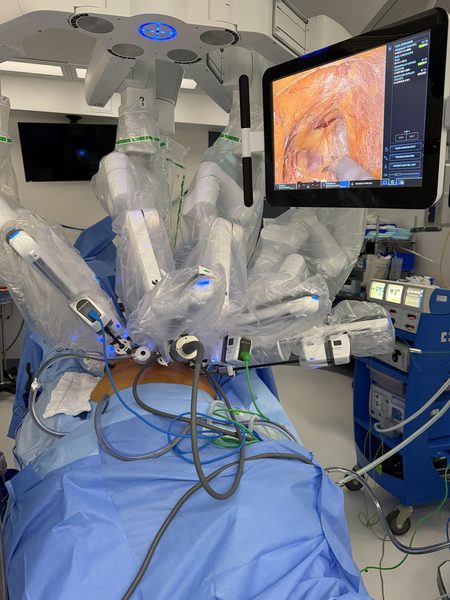
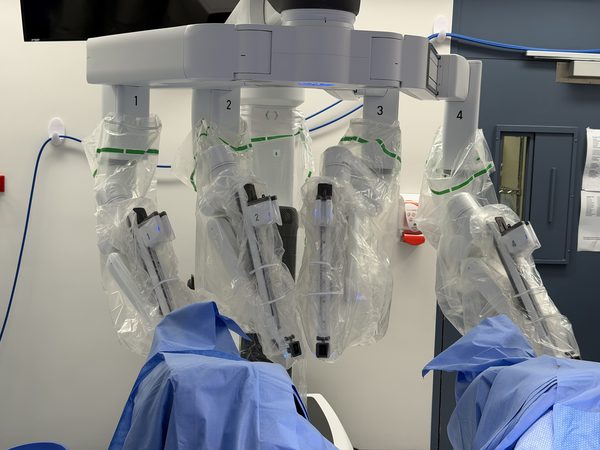
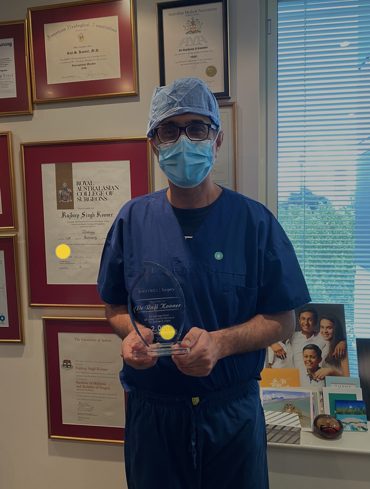
Robotic surgery images






Patient information brochures
These downloadable PDFs are part of the site's patient information brochure library. They are general guides from the named source organisations; please ask at your consultation about what applies to your own care.
References
- Man's kidney removed by robot - The Sunday Telegraph - https://www.dailytelegraph.com.au/news/nsw/robot-removes-kidney/news-story/661e98f5b14efdb9ebd83dc54a1aacd8
- Google Scholar - Raji Kooner - https://scholar.google.com.au/scholar?hl=en&as_sdt=0%2C5&q=raji+kooner&btnG=
- Wooju Jeong, Ramesh Kumar, Mani Menon - Past, present and future of urological robotic surgery - Investig Clin Urol. 2016 Mar; 57(2): 75-83. - doi: 10.4111/icu.2016.57.2.75
- George EI, Brand TC, LaPorta A, et al. Origins of robotic surgery: From skepticism to standard of care. JSLS. 2018;22(4). e2018.00039.
- Chopra H, Baig AA, Cavalu S, et al. Robotics in surgery: Current trends. Ann Med Surg. 2022;17(81):104375.