
Artificial Urinary Sphincter
What is an artificial urinary sphincter?
The artificial urinary sphincter (AUS) is an implanted device used to manage moderate to severe stress urinary incontinence - leakage of urine on activity such as exertion, movement, coughing, laughing or sneezing. In men it is used most commonly when continence has been affected by prostate surgery, and sometimes after radiotherapy.1
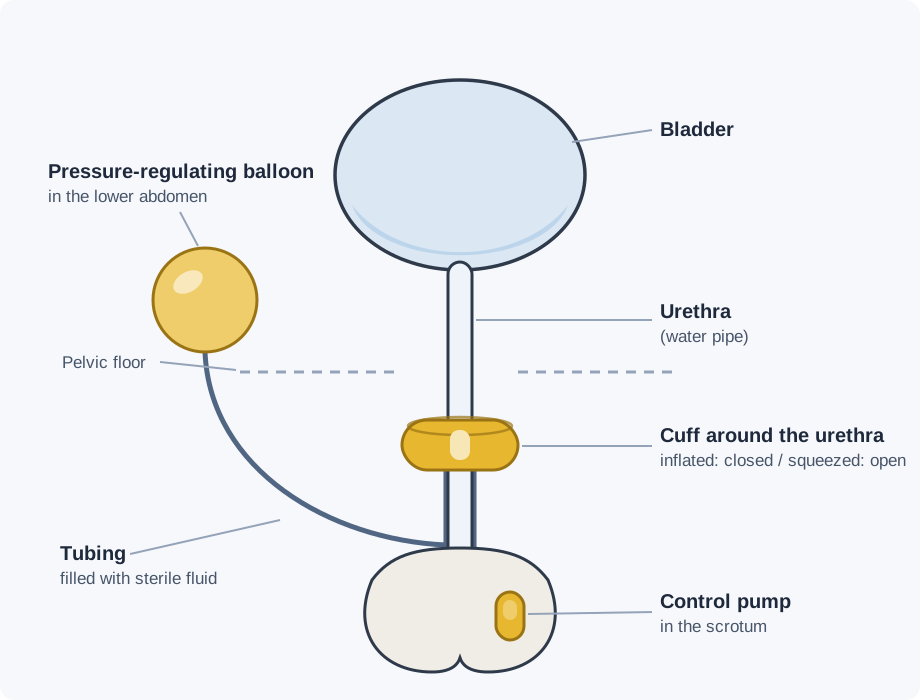
The device is completely concealed inside the body, so there are no external parts and bladder control is discreet. It has three connected parts:1
- a fluid-filled cuff that sits around the urethra (the water pipe);
- a small control pump placed in the scrotum, which you operate by hand; and
- a pressure-regulating balloon in the lower abdomen.
The three components are joined by fine tubing filled with sterile fluid. The cuff usually sits around the bulbar urethra, but it can sometimes be placed at the bladder neck instead.1
How does it work?
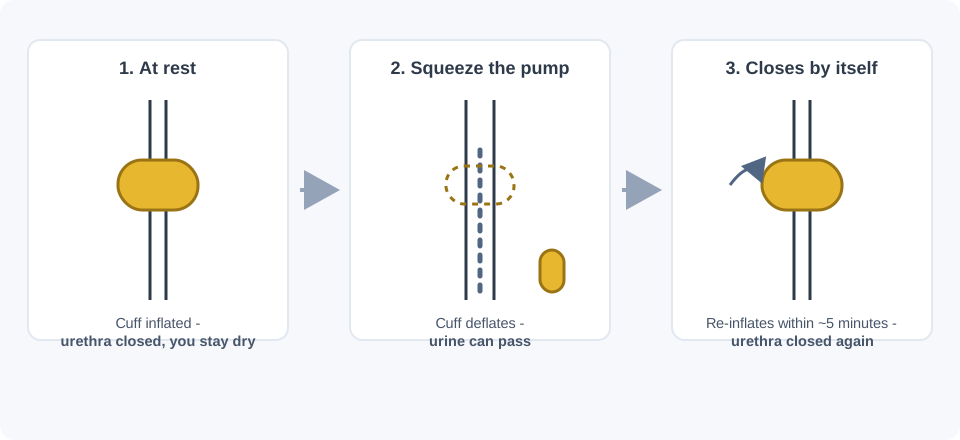
When the cuff is inflated it gently squeezes the urethra closed, which keeps you dry. To pass urine, you squeeze and release the pump in the scrotum a few times; this moves fluid out of the cuff so that it deflates and the urethra opens. The cuff then re-inflates automatically, usually within about five minutes, to close the urethra again.1
After the device is in use, most men are dry or have only minor leaks or dribbles during strenuous exercise or exertion, and most use one pad or less each day for safety to manage these minor leaks.1
Who might it be considered for?
An artificial urinary sphincter is generally considered for men with moderate to severe stress urinary incontinence, most often after radical prostatectomy, where leakage is still a problem after continence has had time to recover and after conservative measures have been tried.1,5 Whether it is suitable in any individual case depends on the degree of leakage, previous treatment (including radiotherapy), the condition of the urethra, and your general health and ability to operate the pump.
Lighter degrees of leakage may be better managed by other measures. In the context of recovery after prostate surgery, pelvic floor exercises under the guidance of a continence advisor or physiotherapist are the usual first step, and a male sling can be a good option for men with minimal leakage. The right choice is decided after assessment, often including a urodynamic assessment and a cystoscopy, and a discussion of the advantages and disadvantages of each option.1,2
Alternatives to consider
- Pelvic floor exercises - under supervision from a continence advisor or physiotherapist, these can improve stress incontinence in a substantial proportion of men, and weight loss and stopping smoking can also help.1
- Male sling - a mesh sling implanted to reposition and support the urethra and restore bladder control. It requires no patient interaction and is best suited to milder leakage.1
- Urethral bulking - injection of a bulking agent into the wall of the urethra. This is not currently recommended by NICE for this indication.1
- Containment and other measures - incontinence pads or a penile sheath, penile clamps, or in selected situations a catheter. These may be appropriate if symptoms are not troublesome or surgery is not wanted.1
The operation
Insertion of an artificial urinary sphincter is carried out in specialist referral centres and is usually performed under a general anaesthetic, sometimes with a spinal anaesthetic; the anaesthetist will discuss the options and pain relief with you.1 In broad terms the operation involves:1
- An injection of antibiotics may be given before the procedure, after checking carefully for allergies.
- An incision is made in the perineum (the area between the back of the scrotum and the anus). If the cuff is to be placed at the bladder neck instead, the incision is made in the lower abdomen.
- The urethra is mobilised and the cuff is positioned around it.
- A further small incision in the abdomen is used to place the pressure-regulating balloon and to pass the control pump down into the scrotum.
- The components are connected with fine tubing filled with sterile fluid, and the skin incisions are closed with dissolvable stitches.
- A catheter is placed in the bladder during the operation; this is often removed before you wake or on the following day, before you go home.
The device is deliberately left deactivated at the end of the operation so that the tissues can heal. During this early period you will still leak and will need to keep using your usual continence aids.1
Recovery and activating the device
Before you go home you will be given advice about your recovery, shown how to avoid activating the device, and told what to do if you cannot pass urine. You will also be shown how to gently "milk" the pump down into the scrotum each day so that it stays in place. A copy of your discharge summary is sent to your GP.1
The pump is activated at a simple outpatient appointment, usually around four to six weeks after the operation, once healing has taken place. Only from this point does the device start to control your continence.1
You will be given a sphincter card with the details of your implanted device. It is important to show this to any clinician involved in your care, because passing a urinary catheter can be dangerous after an AUS and can cause permanent damage if it is not done correctly - the device must be deactivated first by someone familiar with it.1 You should also tell any surgeon about your AUS before any future abdominal, groin or perineal surgery.1
Results
The artificial urinary sphincter is a well-established treatment for stress urinary incontinence after prostate surgery, and is often regarded as the standard option for moderate to severe leakage.5 Published patient information from the British Association of Urological Surgeons reports that approximately 90% of men are satisfied with the outcome of their surgery.1
It is important to understand that the aim of surgery is to improve continence and quality of life rather than to guarantee that you will be completely dry. As above, most men have only minor leaks afterwards and use one pad or less each day for safety.1 Reported success rates vary depending on how "success" and "dryness" are defined in different studies, which is one reason results are best discussed in the context of your own circumstances.4 The device is mechanical and may need revision or replacement over time (see risks below).
Risks and possible complications
As with any operation, an artificial urinary sphincter carries risks, and these should be weighed against the expected benefit. The figures below are taken from the British Association of Urological Surgeons patient information leaflet; the impact of any after-effect varies from person to person, and your surgeon can estimate your individual risk.1
- Common (between 1 in 2 and 1 in 10): swelling and bruising of the wound, perineum and scrotum; longer-term discomfort in the lower abdomen, perineum or scrotum.1
- Occasional (between 1 in 10 and 1 in 50): wound or urinary tract infection needing antibiotics; infection or erosion of the device requiring its removal; mechanical failure of the device needing a further (revision) procedure within 10 years; failure to fully control continence; new urgency incontinence; and urethral shrinkage (atrophy) leading to recurrent leakage and possibly further surgery.1
- Erosion risk and radiotherapy: the risk of the device eroding into the urethra is higher in men who have had previous radiotherapy to the prostate (rising from between 1 in 10 and 1 in 50, to between 1 in 10 and 3 in 10).1
- Rare (between 1 in 50 and 1 in 250): anaesthetic or cardiovascular problems that may need intensive care, including chest infection, clot in the leg (DVT) or lung (pulmonary embolus), stroke, heart attack and, very rarely, death. Your anaesthetist can estimate your individual risk.1
Because the device is mechanical, some men will need a further procedure over the years to revise or replace a part. The need to operate the pump by hand each time you pass urine is also a practical consideration when choosing between treatment options.1
Frequently asked questions
Can other people see or feel the device?
The artificial urinary sphincter is implanted completely inside the body, with no external parts, so it is discreet. The control pump sits within the scrotum where you can reach it to operate it.1
How soon after the operation will I be dry?
The device is left switched off at first to let the tissues heal, so you will still leak in the early weeks and should keep using your usual pads. It is activated at an outpatient appointment around four to six weeks after surgery, and only then does it start to control your continence.1
Will I be completely dry afterwards?
The goal is a meaningful improvement in leakage rather than a guarantee of being completely dry. Most men have only minor leaks during exertion afterwards and use one pad or less each day for safety.1
Does the device last forever?
The artificial urinary sphincter is a mechanical device and can fail over time. A revision procedure to repair or replace a part may be needed within 10 years in a proportion of men.1
Why do I have to carry a sphincter card?
Passing a urinary catheter can be dangerous after an AUS and can cause permanent damage if done incorrectly, because the cuff has to be deactivated first. The card alerts any clinician to the device so a catheter is only passed safely, and you should also mention the device before any future abdominal, groin or perineal surgery.1
What if a sphincter is not right for me?
Other options - pelvic floor exercises, a male sling for milder leakage, or containment measures - may suit you better depending on the severity of your incontinence and your circumstances. The best approach is decided after assessment and a discussion of the advantages and disadvantages of each.1,2
Patient information brochures
The brochures below are reproduced under the BAUS patient information licence and remain copyright of the British Association of Urological Surgeons.
References
- British Association of Urological Surgeons. Insertion of an artificial urinary sphincter (AUS) in men - patient information leaflet A25/144, April 2025. https://www.baus.org.uk/patients/information_leaflets/30/insertion_of_an_artificial_urinary_sphincter_aus_in_men
- British Association of Urological Surgeons. Treatment options for stress urinary incontinence (SUI) - patient information leaflet. https://www.baus.org.uk/patients/information_leaflets/
- Castellan P, Ferretti S, Litterio G, et al. Management of urinary incontinence following radical prostatectomy: challenges and solutions. Ther Clin Risk Manag. 2023;19:43-56. doi:10.2147/TCRM.S283305
- Linder BJ, Rangel LJ, Elliott DS. Evaluating success rates after artificial urinary sphincter placement: a comparison of clinical definitions. Urology. 2018 Mar;113:220-224. doi:10.1016/j.urology.2017.10.033
- Herschorn S. The artificial urinary sphincter is the treatment of choice for post-radical prostatectomy incontinence. Can Urol Assoc J. 2008 Oct;2(5):536-539. doi:10.5489/cuaj.924