
UroLift (Prostatic Urethral Lift)
At a glance
- What it is: A minimally invasive day procedure for benign prostatic hyperplasia (BPH). Small permanent implants are placed across the prostatic urethra to hold the two obstructing lateral lobes of the prostate apart, opening the urinary channel without cutting, heating or removing tissue.1,2,11
- How it differs from other BPH operations: Standard surgical options for BPH (TURP, holmium laser enucleation, GreenLight laser) work by removing or vaporising prostate tissue. UroLift is mechanical: nothing is cut or removed, so there is no need for an extended catheter period or in-patient stay in most cases, and there is no specimen for pathology.1,2,3,11
- Who it suits: Selected men with prostate volumes typically in the 30 to 80 mL range whose obstruction is predominantly from the lateral lobes. UroLift is also approved for selected obstructing median-lobe anatomy after the MedLift study (FDA expanded indication, 2018).1,4,11,12
- What the evidence shows: The pivotal randomised L.I.F.T. trial (Roehrborn et al. 2013) and its 5-year follow-up reported durable improvements in symptoms (IPSS), urinary flow (Qmax) and quality of life, with preservation of erectile and ejaculatory function.1,2 The randomised BPH6 study (Sonksen 2015, Gratzke 2017) compared UroLift directly against transurethral resection of the prostate (TURP) and reported faster recovery and better preservation of sexual function with UroLift, accepting that TURP delivered a larger improvement in flow rate.5,6
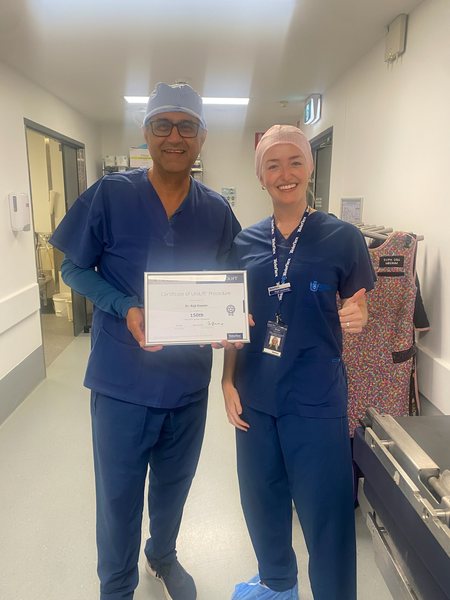
- Where Urology NSW sits: Dr Raji Kooner has performed more than 150 UroLift System procedures, formally recognised by the Teleflex Academy in April 2025. He is a Teleflex-designated UroLift proctor and trains other Australian surgeons in the technique. UroLift sits alongside the full spectrum of other BPH options offered through the practice.
What is UroLift?
UroLift is the trade name of the prostatic urethral lift (PUL) system manufactured by Teleflex. Each implant is a small permanent device made of three components: a nitinol (nickel-titanium) capsular tab placed on the outside of the prostate, a non-absorbable polyester suture in the middle, and a stainless-steel urethral end-piece on the inside of the urinary channel.11,12 Through a standard cystoscope, the delivery tool is passed along the urethra and a needle deploys each implant across the obstructing prostate tissue. The suture is tensioned so that the lateral lobe is retracted outwards toward the prostate capsule - holding the obstructing tissue aside in much the same way curtains are pulled aside from a window.1,2,11
Typically four to six implants are placed, usually two to three per side, depending on the length and shape of the prostate.1,2,11 No tissue is cut, vaporised, frozen or removed. The implants stay in place permanently and are designed to be MR-conditional under the labelling specified by the manufacturer.11 Because there is no thermal injury and no cavity to heal, urinary improvement begins quickly and most men do not need a long catheter period, with about one in three published series reporting catheter-free discharge.2,3

UroLift received US FDA clearance for treatment of symptoms of BPH in 2013, and an expanded FDA indication for selected obstructing median-lobe anatomy in 2018 (the MedLift configuration).11,12 It is recognised in current international guidelines as one of the established minimally invasive surgical therapies (MIST) for BPH alongside Rezum water vapour therapy, the iTind temporary implant, prostatic artery embolisation and aquablation.13,14,15
How is UroLift different from other BPH treatments?
Treatments for an obstructing prostate fall into three broad groups, and UroLift has different trade-offs against each:
- Versus medication (alpha blockers, 5-alpha reductase inhibitors). UroLift acts mechanically and most men feel a difference within days to two weeks, rather than the weeks-to-months timescale of medication.1,2 The L.I.F.T. randomised trial reported a larger and more durable improvement in symptoms with UroLift than the medication-only comparator at 12 months, and 5-year follow-up showed sustained benefit with the option to add a second BPH procedure later if needed.1,2
- Versus tissue-removing surgery (TURP, holmium laser enucleation [HoLEP], GreenLight laser, simple prostatectomy). Tissue-removing operations produce a larger and more durable improvement in flow rate (Qmax) and a lower long-term retreatment rate than UroLift, but they more often involve an overnight stay, a longer catheter period, and a higher rate of retrograde ejaculation (loss of forward ejaculation).5,6 UroLift's main attractions in this comparison are faster recovery, a low rate of retrograde ejaculation in published series, and preservation of erectile function.1,2,5,6
- Versus other minimally invasive options (Rezum water vapour, iTind temporary implant, aquablation, prostatic artery embolisation). Each of the MIST options has its own size range, anatomical preferences and recovery profile.13,14,15 UroLift's distinguishing features are the mechanical mechanism, the absence of thermal injury, the option to perform under light sedation or local anaesthesia, and the rapid onset of symptom relief.1,2,3 A short comparison of each option is on the BPH treatment options page.
Two anatomical features mostly drive whether UroLift is the right mechanical fit:
- Predominantly lateral-lobe obstruction - the original FDA indication, where two pairs of implants hold the lateral lobes aside.1,2,11
- An obstructing median lobe - traditionally a relative contraindication, now treatable in selected anatomies under the FDA-cleared MedLift technique with additional implants placed across the median-lobe tissue (Rukstalis 2019).4,12
What the evidence shows
UroLift has one of the larger evidence bases of the minimally invasive BPH options, with a published randomised pivotal trial, a randomised head-to-head comparison against TURP, and durability data extending to 5 years.
The L.I.F.T. pivotal randomised trial and 5-year durability
The Luminal Improvement Following Prostatic Tissue Approximation for the Treatment of LUTS Secondary to BPH (L.I.F.T.) study (Roehrborn et al. 2013) was the prospective, multicentre, randomised, blinded pivotal trial that supported FDA clearance.1 206 men with moderate-to-severe lower urinary tract symptoms were randomised 2:1 to UroLift or sham. UroLift produced a clinically meaningful improvement over sham in International Prostate Symptom Score (IPSS), maximum urinary flow rate (Qmax) and quality of life at 3 months, with preservation of erectile and ejaculatory function on validated questionnaires.1
Long-term follow-up of the L.I.F.T. cohort to 5 years (Roehrborn et al. 2017, Canadian Journal of Urology) reported sustained improvements in IPSS, Qmax and quality of life. Surgical retreatment with another BPH procedure occurred in approximately 13.6% of patients over the 5-year follow-up; sexual function (both erectile function and ejaculatory function) remained preserved at 5 years on validated questionnaire scores.2
The BPH6 randomised study (UroLift vs TURP)
The BPH6 study (Sonksen et al. 2015, Gratzke et al. 2017) was a European prospective randomised trial that compared UroLift directly against TURP in 80 men using a composite endpoint of symptom relief, recovery experience, erectile function, ejaculatory function, continence and safety.5,6 TURP achieved the larger improvement in maximum flow rate. UroLift achieved better recovery experience, better preservation of ejaculatory function, and a comparable IPSS improvement, with the composite endpoint favouring UroLift overall at 12 months and the symptom and ejaculation advantages persisting to 24 months.5,6
The take-home from BPH6 in the consent conversation is that the choice between UroLift and a tissue-removing operation (TURP, HoLEP, GreenLight) is rarely about which one "works"; both work. The difference is that tissue removal usually delivers a larger flow improvement and a lower long-term retreatment rate, while UroLift usually delivers faster recovery, a lower rate of retrograde ejaculation and the option of performing the procedure under light sedation or local anaesthesia.5,6
Median-lobe (MedLift) extension of the indication
Until 2018 an obstructing median lobe of the prostate was a relative contraindication to UroLift. Rukstalis et al. (2019) reported a prospective single-arm study (the MedLift study) of UroLift in 45 men with an obstructing median lobe, showing improvement in IPSS, Qmax and quality of life at 12 months with preservation of sexual function and acceptable safety. The study supported the 2018 FDA-cleared expansion of the indication to include obstructing median-lobe anatomy.4,12
Real-world series, multicentre registries, and retreatment
Multiple real-world series and registries have reported on UroLift outside the controlled trial setting. A prospective real-world registry analysis by Eure et al. (2019) reported safety and short-term effectiveness consistent with the L.I.F.T. trial, including a low rate of de novo sexual dysfunction.3 Larger administrative-data analyses of the medium-term retreatment rate have reported retreatment with another BPH procedure in roughly 10 to 20% of patients over the first five to seven years post-UroLift, depending on cohort and definition - in line with the L.I.F.T. 5-year retreatment figure.2 Importantly, prior UroLift does not preclude later TURP, holmium laser enucleation, or other BPH procedures - the implants can be worked around or removed at the subsequent operation.2
Position in current guidelines
UroLift / prostatic urethral lift is recognised as an established minimally invasive surgical therapy for BPH in current international guidelines:
- European Association of Urology (EAU) guidelines on management of non-neurogenic male LUTS (2024 update). PUL is one of the listed minimally invasive options for selected men, with the mechanism, indications and limitations described above.13
- American Urological Association (AUA) / Society of Urodynamics, Female Pelvic Medicine and Urogenital Reconstruction (SUFU) guideline on BPH/LUTS surgical management (2024 amendment). PUL is recognised as an option for men with prostates 30 to 80 mL, including selected obstructing median-lobe anatomy, with the recovery, ejaculatory and retreatment trade-offs explicitly described.14
- National Institute for Health and Care Excellence (NICE). NICE Medical Technologies Guidance MTG58 (2021) recommended the UroLift System as a treatment option in selected men with BPH on the basis of the available evidence on symptom improvement, sexual-function preservation, faster recovery and resource considerations.15
Where the evidence is not yet definitive
- There are no randomised trials extending past about 5 years for UroLift; longer-term durability is inferred from the L.I.F.T. extension study and from real-world registry data.2,3
- Comparative randomised data against newer minimally invasive options (Rezum water vapour, iTind temporary implant, aquablation) are limited; most direct comparisons are observational.13,14
- Outcomes in very large prostates (greater than 80 mL) are not as well characterised as in the 30 to 80 mL range, and most published evidence does not support UroLift as a stand-alone treatment in men with very large glands.13,14
- A defined proportion of men require a second BPH procedure over time. The L.I.F.T. 5-year retreatment rate of approximately 13.6% is the most commonly cited figure; real-world rates vary by cohort and follow-up.2
Conditions in which UroLift may be considered
- Moderate-to-severe lower urinary tract symptoms from BPH (typically IPSS 8 or above) where the prostate volume is in the 30 to 80 mL range and the obstruction is predominantly from the lateral lobes.1,2,11
- Selected obstructing median-lobe anatomy, treated with the additional MedLift implant configuration (FDA-cleared 2018).4,12
- Men in whom preservation of antegrade ejaculation is a particular priority - including younger men, men still in active sexual relationships, and men in whom retrograde ejaculation has been identified as a deal-breaker.1,2,5,6
- Men who are unfit for, or wish to avoid, general anaesthesia - UroLift can be performed under light sedation or, in selected cases, under local anaesthesia.10
- Men on long-term anticoagulation in whom the bleeding risks of a tissue-removing operation are higher (with hospital protocol around peri-procedural anticoagulation management).13
- Men in urinary retention, in selected cases - with the explicit understanding that a tissue-removing operation generally has a higher chance of returning to spontaneous voiding, and that a longer follow-up may be required to confirm whether UroLift has lifted the patient out of retention.13,14
Who is suitable?
UroLift is most often considered for:
- Men in the 30 to 80 mL prostate-volume range whose anatomy is dominated by lateral-lobe obstruction.1,2,11
- Men with selected median-lobe anatomy under the MedLift indication.4,12
- Men whose priorities are fast recovery, preservation of sexual function, and avoiding an inpatient stay where possible.1,2,5,6
- Men on anticoagulation, men unfit for prolonged general anaesthesia, and men who wish to avoid the catheter time associated with tissue-removing operations.10,13
UroLift is usually not the right choice for:
- Men with very large prostates (greater than approximately 80 to 100 mL) where the published evidence does not support UroLift as a stand-alone treatment.13,14
- Men whose obstruction is dominated by an extensive intra-vesical median lobe that is beyond the MedLift indication.4,12,14
- Men in whom the priority is the largest possible improvement in flow rate or the lowest possible retreatment rate over the medium to long term - in whom a tissue-removing operation (TURP, holmium laser enucleation, GreenLight laser, simple prostatectomy) is generally a better fit.5,6,13,14
- Men with bladder stones, suspected prostate cancer requiring open or robotic surgery, or other indications where the prostate operation needs to do more than relieve obstruction.13,14
Each recommendation is made for the individual patient after a full history, examination, urinary flow study, prostate ultrasound, cystoscopy where indicated, and review of any relevant imaging. Where two options are reasonable, the choice is the patient's, after a full discussion of trade-offs.
How is UroLift performed?
- Anaesthesia. UroLift is most commonly performed under light sedation with a perineal nerve block, or under general anaesthesia, in a day-procedure theatre. Selected cases can be performed under local anaesthesia alone.10
- Cystoscopic assessment. A standard rigid cystoscope is passed along the urethra to confirm the prostate anatomy, the length of the prostatic urethra, the size and shape of the lateral lobes, and any median-lobe component. The treatment plan (number of implants and their position) is finalised at this point.1,11
- Implant deployment. The UroLift delivery tool is passed through the cystoscope sheath. The tool is rotated so that the needle is aimed at the obstructing lateral lobe, the needle is fired across the prostate, and the implant (capsular tab on the outside, suture, urethral end-piece on the inside) is deployed and tensioned. The lateral lobe is held back, opening the channel.1,11
- Sequential implants. Typically two implants are placed on each side at slightly different levels along the prostatic urethra. For obstructing median-lobe anatomy, additional implants are placed using the MedLift technique to hold the median-lobe tissue back as well.4,12
- Final inspection. The cystoscope is passed back along the prostatic urethra to confirm a wide open channel, that no implant has migrated and that there is no significant active bleeding.1,11
- Catheter (if used) and discharge. A catheter is not always required. About one in three men in published series go home without a catheter; the remainder have a catheter for a short period - typically a few hours to overnight. Most patients are discharged home from the day-surgery unit on the day of the procedure.2,3,7
Operative time is short - typically 15 to 30 minutes of skin-to-skin time, plus anaesthetic and recovery time.2,7
What to expect: hospital stay and early recovery
Length of stay. UroLift is a day procedure in the great majority of cases. Most men are admitted in the morning and discharged home in the afternoon.2,3
Catheter. A catheter is not always needed. Where one is used, it is typically removed within hours to overnight. A catheter trial is arranged for the small number of men who do not pass urine immediately after removal.2,3
Pain. Most men describe discomfort, urinary urgency or burning on passing urine for one to two weeks. Most manage on simple oral analgesia (paracetamol with or without a short course of anti-inflammatories where appropriate). Heavier opioid use is uncommon.2,3
Blood in the urine. Light bleeding for several days is normal. It usually settles without intervention. Drinking plenty of water helps.2,3
Return to activity. Walking from the day of the procedure. Desk-type work is usually possible within a few days. Avoid heavy lifting, cycling and strenuous exercise for approximately one to two weeks while the urethra settles.
Symptom improvement. Some improvement is usually noticed within the first two weeks; the maximum benefit is generally reached by 6 to 12 weeks, in line with the L.I.F.T. trial timeline.1,2
Sexual function. Erectile function and antegrade (forward) ejaculation are preserved in published UroLift series, with no measurable change in validated questionnaire scores at 1 year and at 5 years in the L.I.F.T. cohort.1,2 This is the central reason many men choose UroLift over a tissue-removing operation; it is not a guarantee for any individual patient.
Follow-up. A clinic review is arranged at around 4 to 6 weeks to confirm symptom improvement, check the urinary flow if appropriate, and discuss any persistent symptoms. Long-term follow-up is structured around symptom score and uroflow at clinically appropriate intervals.
Risks and complications
Every patient is counselled on the following before the procedure. The published rate of significant complication after UroLift is low, but it is not zero, and a defined proportion of men will need additional treatment over time.1,2,3,8
- Dysuria, urinary urgency, frequency. Common in the first one to two weeks. Self-limiting.1,2,3
- Haematuria (blood in the urine). Common, light, self-limiting in most men. A small minority require a short period of irrigation or a longer catheter time.1,2
- Urinary retention. Uncommon; managed by re-insertion of a catheter for a short period and a repeat trial of void.1,2,3
- Urinary tract infection. A short course of antibiotic prophylaxis is given according to hospital protocol; a small number of men develop a UTI requiring treatment.1,2
- Implant displacement, migration or misplacement. Rare. May require adjustment or replacement at a subsequent procedure.1,8
- Encrustation around the urethral end-piece. Uncommon; may present years after the procedure, particularly in men with concurrent stone disease, and may require endoscopic management.8
- Awareness of the implants. A small minority of men describe an awareness of the implants with a full bladder or during sexual activity. Usually self-limited.
- Pelvic, perineal or penile pain. Uncommon, usually short-lived.
- Sexual side effects. Rates of new erectile dysfunction or new retrograde ejaculation in published UroLift series are low and have not been shown to differ from baseline at 1 and 5 years; this is the main published advantage of UroLift over TURP, but it is not zero risk.1,2,5,6
- Need for further treatment. A defined proportion of men will need a further BPH procedure over time. The L.I.F.T. 5-year surgical retreatment rate was approximately 13.6%; real-world figures vary.2 Prior UroLift does not preclude later TURP, holmium laser enucleation or another BPH operation.2
- Anaesthetic and general procedural risks. Standard for any cystoscopic day procedure under sedation or general anaesthesia.
UroLift at Urology NSW
Dr Raji Kooner has performed more than 150 UroLift System procedures, formally recognised by the Teleflex Academy in April 2025. He is a Teleflex-designated UroLift proctor and trains other Australian urologists in the technique. UroLift is one of several BPH treatments routinely offered through the practice.

UroLift sits alongside the practice's other BPH options: holmium laser enucleation (HoLEP), Rezum water vapour therapy, iTind temporary implant, transurethral resection of the prostate (TURP), and the hybrid laser-and-UroLift approach in selected men. A short comparison of every option is on the BPH treatment options page; the simpler patient-facing summary is on the enlarged prostate hub.
Whether UroLift is the right option in any individual case depends on prostate size and shape, the dominant pattern of obstruction, urinary flow studies, fitness for anaesthesia, sexual-function priorities and personal preferences. The same review can also confirm whether one of the tissue-removing options or one of the other minimally invasive options is the better fit. There is no fee for a discussion about which BPH option is appropriate; it is part of the standard consultation.
Patients who would like to discuss whether UroLift is appropriate for them are welcome to request a second opinion or to telephone the rooms to arrange a consultation.
Frequently asked questions
Will UroLift cure my BPH?
No procedure for BPH is a "cure" in the sense that the prostate stops growing. UroLift is a durable mechanical treatment that opens the prostatic channel; the L.I.F.T. trial showed sustained symptom and flow improvement at 5 years, and approximately 13.6% of patients had a further BPH procedure within that 5-year window.1,2 Long-term follow-up beyond 5 years is the role of the registry data and the published real-world series.3
Will I be awake?
Most often UroLift is performed under light sedation with a perineal nerve block, or under general anaesthesia. Selected cases can be performed under local anaesthesia alone.10 Your anaesthetist will discuss the right choice for you.
Will I need a catheter?
Often not. About one in three men in published series go home without a catheter; the remainder have a catheter for a few hours to overnight.2,3
Does UroLift preserve sexual function?
Erectile function and antegrade (forward) ejaculation were preserved on validated questionnaire scores in the L.I.F.T. randomised trial at 1 year and at 5-year follow-up, and UroLift had a clear advantage over TURP for ejaculatory function in the BPH6 randomised study.1,2,5,6 This is one of the main reasons many men choose UroLift; it is a real and measurable advantage in the literature, but it is not a guarantee for any individual patient.
What if my prostate is too big?
UroLift is typically used in prostates 30 to 80 mL. In larger prostates, the published evidence does not support UroLift as a stand-alone treatment, and a tissue-removing operation (typically holmium laser enucleation or simple prostatectomy) is the better-fit option.13,14 The hybrid laser-and-UroLift approach is an option in selected intermediate cases and is discussed at consultation.
What if I have a median lobe?
An obstructing median lobe was a relative contraindication to UroLift until the FDA-cleared MedLift indication in 2018. Selected median-lobe anatomies can now be treated with additional implants placed across the median-lobe tissue (Rukstalis 2019).4,12 Whether this is right for you depends on the specific anatomy on cystoscopy.
Will I need another procedure later?
Some men do. In the L.I.F.T. 5-year extension, approximately 13.6% of patients had a further BPH procedure within 5 years.2 Real-world figures vary by cohort and follow-up. Importantly, prior UroLift does not preclude any later BPH procedure - TURP, holmium laser enucleation, or another option remains available if needed.2
Are the implants safe in MRI?
The UroLift implants are MR-conditional under the labelling specified by the manufacturer (please tell the radiology department before any MRI scan).11
Is UroLift covered by Medicare and private health insurance?
UroLift is performed under a defined Medicare item number for prostatic urethral lift and is generally covered by Australian private health insurance at the appropriate procedure code. Funding details, hospital fees and any out-of-pocket gap can be quoted by the rooms.
Video of the UroLift procedure performed by Dr Kooner
UroLift recognition image
References
- Roehrborn CG, Gange SN, Shore ND, Giddens JL, Bolton DM, Cowan BE, Brown BT, McVary KT, Te AE, Gholami SS, Rashid P, Moseley WG, Chin PT, Dowling WT, Freedman SJ, Incze PF, Coffield KS, Borges FD, Rukstalis DB. The prostatic urethral lift for the treatment of lower urinary tract symptoms associated with prostate enlargement due to benign prostatic hyperplasia: the L.I.F.T. study. Journal of Urology. 2013;190(6):2161-2167. doi:10.1016/j.juro.2013.05.116. PubMed PMID: 23764081.
- Roehrborn CG, Barkin J, Gange SN, Shore ND, Giddens JL, Bolton DM, Cowan BE, Cantwell AL, McVary KT, Te AE, Gholami SS, Moseley WG, Chin PT, Dowling WT, Freedman SJ, Incze PF, Coffield KS, Herron S, Rashid P, Rukstalis DB. Five year results of the prospective randomized controlled prostatic urethral L.I.F.T. study. Canadian Journal of Urology. 2017;24(3):8802-8813. PubMed PMID: 28646935.
- Eure G, Gange S, Walter P, Khan T, Chabert C, Mueller T, Yu A, Patel A, Henderson J, Zorn KC, Bhojani N, Rukstalis D. Real-world evidence of prostatic urethral lift confirms pivotal clinical study results: 2-year outcomes of a retrospective multicenter study. Journal of Endourology. 2019;33(7):576-584. doi:10.1089/end.2019.0167. PubMed PMID: 31115249.
- Rukstalis D, Grier D, Stroup SP, Tutrone R, deSouza E, Freedman S, Garcia-Salas E, Coffield S, Barkin J, Wilson C, Roehrborn CG. Prostatic Urethral Lift (PUL) for obstructive median lobes: 12 month results of the MedLift Study. Prostate Cancer and Prostatic Diseases. 2019;22(3):411-419. doi:10.1038/s41391-018-0118-x. PubMed PMID: 30664733.
- Sonksen J, Barber NJ, Speakman MJ, Berges R, Wetterauer U, Greene D, Sievert KD, Chapple CR, Montorsi F, Patterson JM, Fahrenkrug L, Schoenthaler M, Gratzke C. Prospective, randomized, multinational study of prostatic urethral lift versus transurethral resection of the prostate: 12-month results from the BPH6 study. European Urology. 2015;68(4):643-652. doi:10.1016/j.eururo.2015.04.024. PubMed PMID: 25937539.
- Gratzke C, Barber N, Speakman MJ, Berges R, Wetterauer U, Greene D, Sievert KD, Chapple CR, Patterson JM, Fahrenkrug L, Schoenthaler M, Sonksen J. Prostatic urethral lift vs transurethral resection of the prostate: 2-year results of the BPH6 prospective, multicentre, randomized study. BJU International. 2017;119(5):767-775. doi:10.1111/bju.13714. PubMed PMID: 27862831.
- McNicholas TA, Woo HH, Chin PT, Bolton D, Fernandez Arjona M, Sievert KD, Schoenthaler M, Wetterauer U, Vrijhof EJ, Gange S, Roehrborn CG. Minimally invasive prostatic urethral lift: surgical technique and multinational study. European Urology. 2013;64(2):292-299. doi:10.1016/j.eururo.2013.01.008. PubMed PMID: 23357348.
- Shore N, Tutrone R, Roehrborn CG. Long-term safety, durability and learning-curve outcomes of the prostatic urethral lift in real-world urology practice. BJUI Compass. Published reviews of registry data on UroLift retreatment, encrustation and adverse events.
- Martin SA, Haren MT, Marshall VR, Lange K, Wittert GA. Prevalence and factors associated with uncomplicated storage and voiding lower urinary tract symptoms in community-dwelling Australian men. World Journal of Urology. 2011;29(2):179-184. doi:10.1007/s00345-010-0605-8. PubMed PMID: 20963421.
- Barkin J, Giddens J, Incze P, Casey R, Richardson S, Gange S. UroLift system for relief of prostate obstruction under local anesthesia. Canadian Journal of Urology. 2012;19(6):6217-6222. PubMed PMID: 23228286.
- Teleflex / NeoTract. UroLift System Instructions for Use and product information. (Manufacturer documentation; current version varies by region.) https://www.urolift.com/
- US FDA. 510(k) premarket notification: UroLift System (NeoTract Inc.) - original clearance for treatment of symptoms of BPH (2013); expanded indication including obstructing median lobe (MedLift), 2018. (FDA 510(k) database.)
- Cornford P, van den Bergh RCN, Briers E, et al. EAU-EANM-ESTRO-ESUR-ISUP-SIOG Guidelines on the Management of Non-neurogenic Male Lower Urinary Tract Symptoms (2024 update). European Association of Urology. https://uroweb.org/guidelines/management-of-non-neurogenic-male-luts
- Sandhu JS, Bixler BR, Dahm P, Goueli R, Kirkby E, Stoffel JT, Wilt TJ. Management of Lower Urinary Tract Symptoms Attributed to Benign Prostatic Hyperplasia (BPH): AUA Guideline (Amended 2024). American Urological Association / Society of Urodynamics, Female Pelvic Medicine and Urogenital Reconstruction. https://www.auanet.org/guidelines-and-quality/guidelines/benign-prostatic-hyperplasia-(bph)-guideline
- National Institute for Health and Care Excellence. UroLift for treating lower urinary tract symptoms of benign prostatic hyperplasia. NICE Medical Technologies Guidance MTG58, 2021. https://www.nice.org.uk/guidance/mtg58